
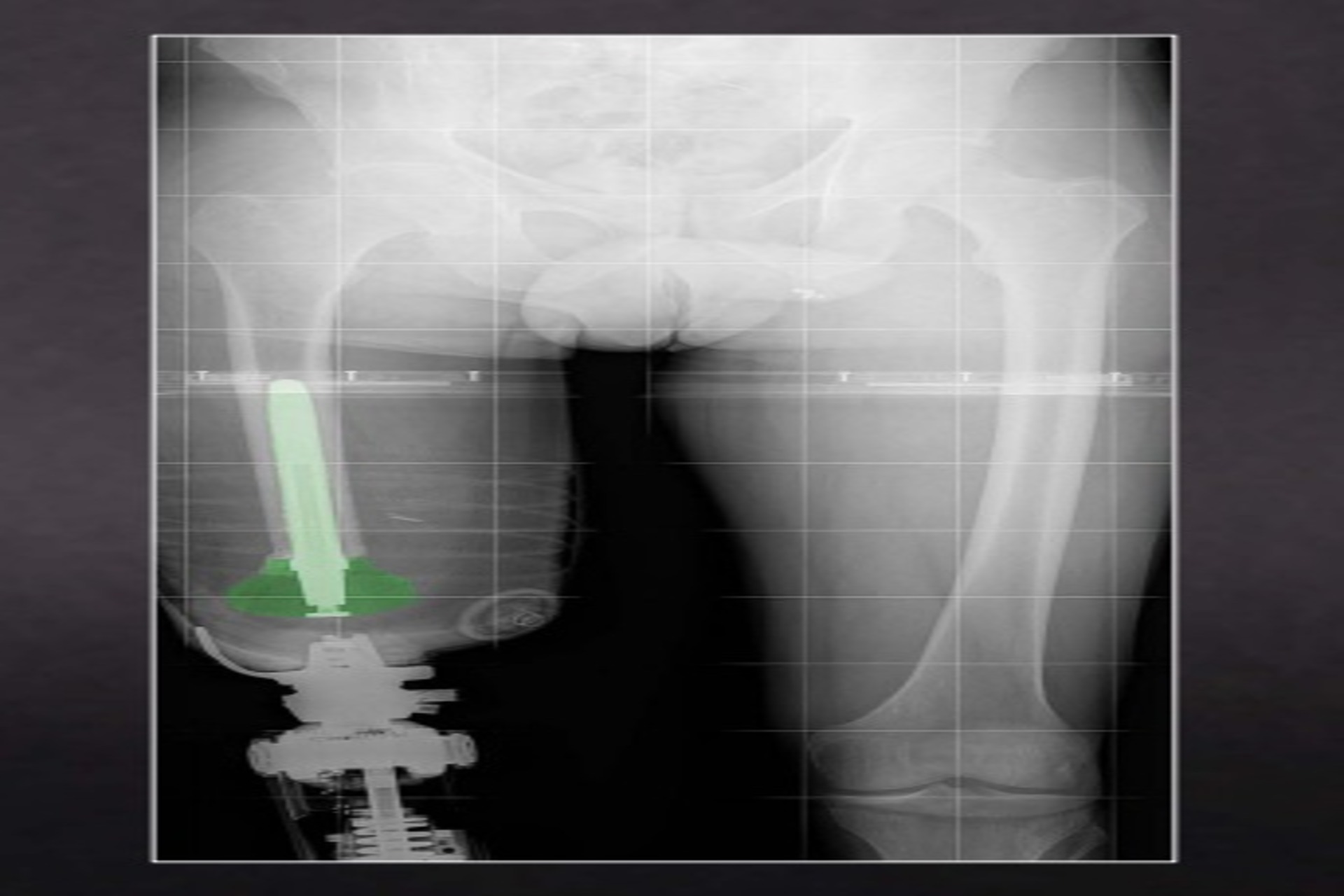
The Keep Walking Implant — A Solution for Lower-Limb Amputees with an Intact Femur or at Least 14 cm of Femur Preserved
The Keep Walking femoral implant, made at the time by Tequir, offers an osseointegrated solution for patients with knee-level amputations, featuring a titanium alloy stem and a high-density polyethylene spacer.
After a knee-level leg amputation, many patients see their doctor about an external prosthesis, fearing that losing the distal part of the femur will change their lives forever. What's new is that this type of implant can greatly improve their quality of life. Many fear pain; others worry that over time the other leg will start to hurt, or that the weight-bearing leg will suffer in the long run. This is why many physicians turn to the Keep Walking femoral implant, made at the time by Tequir, to create a stable connection with the external prosthesis. But why do they do this?
What the Keep Walking implant is made of
The femoral implant consists of two parts:
The femoral stem. Made from titanium alloy meeting the ASTM F-136 standard, which facilitates anchoring within the residual femoral canal. The stem length ranges from 120-180 mm and has a
diameter of 11-17 mm.
The cup, or spacer. Made from high-density polyethylene with a diameter of 54-62 mm, it connects distally to the stem via a titanium screw and a threaded polyethylene sleeve. The cup allows distal weight-bearing, with the load distributed directly through the femur.
How the surgery is performed.
The surgical procedure depends on the patient's existing scarring. A resection is performed at the distal end of the femur, and the femoral canal is widened to reach an appropriate diameter. This means enough space must be created for the implant stem. The correct implant size must be determined — stem length and diameter, as well as cup size — allowing the implant to be closed without placing tension on the soft tissue. All the steps to follow are also set out in the implant's instructions for use. So, moving on to the operation itself: the implant is inserted into the femur, and the soft tissue is closed with a proper myoplasty, which will
fully cover the polyethylene cup.
How it is used
But how is it inserted? There are several techniques: the press-fit technique, the cemented technique, and early or delayed implantation surgery.
Press-fit technique. The implant is driven into the medullary canal with a mallet, keeping it as aligned with the femur as possible, until the spacer makes contact with the distal surface of the femur.
Cemented technique. If the femur cannot withstand the impact on the cortical bone, or if the cortical section is thinner than 3 mm, the cemented technique is recommended. This requires an intramedullary cement plug sized and shaped to match the medullary canal.
Early implantation surgery. Check whether any major blood vessel is bleeding before closing the operation, especially if a sleeve was used. If there is excess muscle tissue, this will cause problems with
fitting the prosthesis. The excess tissue must therefore be removed. A myoplasty covering the entire implant should be attempted. Take care that the skin suture is not left under tension, since excess subcutaneous fat will interfere with fitting the posterior prosthesis.
Delayed implantation surgery. The same procedure applies in this case.
What are the benefits of using the Keep Walking implant
To make the most of the implant's advantages, it is important to pay attention to:
✔ Compression bandaging. A good compression bandage (elastic and applied obliquely) is needed after amputation, so that no volume changes occur by the time the definitive socket is fitted.
✔ Distal support. The distal weight-bearing surface of a patient with a Keep Walking implant is similar to that of patients who have undergone a knee disarticulation. The socket should therefore provide distal support with ischial containment.
✔ Spacer adjustments. The distal end of the socket must be fitted to the full circumference of the spacer. This allows the patient to control the prosthesis. Here are some of the other benefits observed with the implant in clinical studies.
Other benefits observed with the implant in clinical studies
One study involving patients with an average age of 63, with amputations due to vascular, traumatic, or oncological causes, found that the distal-loading implant improves walking capacity and speed within 14 months of implantation at most — particularly in male patients over 50 with vascular-related amputations. Testing was carried out 3 months after amputation.
According to another study involving 29 patients — one of whom was excluded for not completing the program, and 5 of whom required implant removal — the implant was found to be beneficial for increasing bone mineral density.