
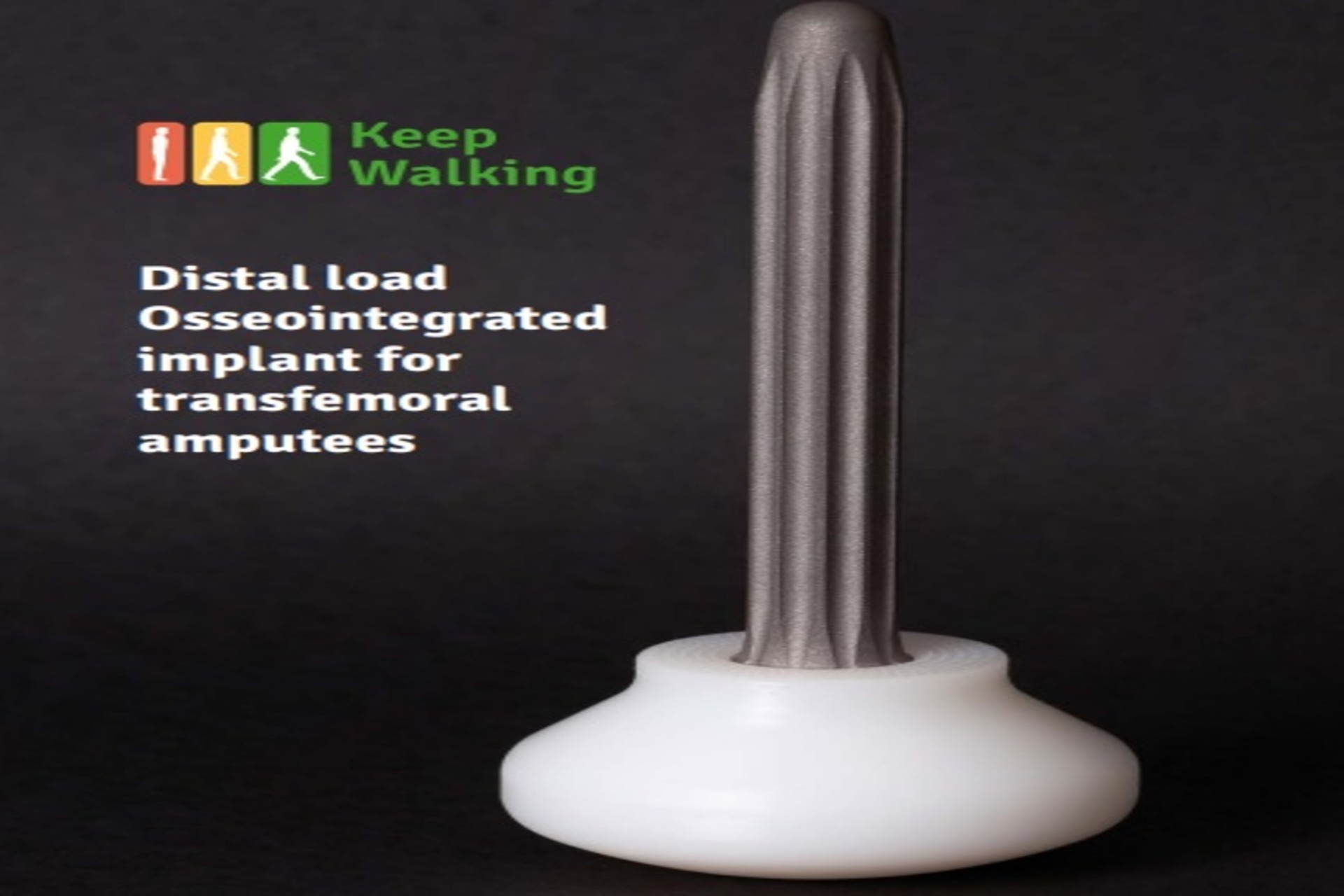
An Innovative Solution for Patients with Lower-Limb Amputation: The Keep Walking Implant
The Keep Walking femoral implant offers an alternative for patients with a tibial (below-knee) amputation or whose remaining femur measures at least 16 cm, improving gait and comfort with external prosthetics.
If you have had a below-knee (tibial) amputation, or if at least 16 cm of your femur remains, and you want to improve your gait, achieve better body posture and spatial orientation, and enjoy greater comfort when using an external prosthesis, the Keep Walking femoral implant is the solution for you.
Whether your leg was amputated due to vascular disease, trauma, or a tumor, you can benefit from the Keep Walking implant. It doesn't matter whether your amputation is about to take place or has already happened — read on to find out how this implant can help you.
What the implant is made of
The implant consists of a stem, a spacer or cup, and a fixation system. The stem is made of grooved titanium with a rough surface to ensure osseointegration and proper fixation of the implant, as well as the transmission of
load through the femur. Its diameter ranges from 12–17 mm, and its length from 120 mm to 180 mm.
The spacer, or cup, is made of polyethylene. This part of the implant remains in contact with the base of the femur and is covered by soft tissue. The spacer supports the femur and allows for efficient distal loading. It also gives you superior control over the external prosthesis, and is available in three sizes: 54, 58, and 62 mm.
The fixation system is used to assemble the implant.
What are the benefits of the implant
First of all, the Keep Walking implant offers high resistance. With this implant, you'll be able to move around with less assistance, thanks to a considerable improvement in biomechanics.
You'll feel less discomfort at the point of contact when using the external prosthesis, since reliance on ischial support is reduced. Control over the prosthesis improves, along with femoral function overall. The implant provides distal support within the socket, allowing the femur to bear weight once again.
How quickly will I recover after the implant
According to a study of a group of patients who underwent implant surgery, wounds were found to heal within 15 days of the operation. However, a great deal of training and determination is needed before you can move around on your own, or with only minimal assistance. Here is what the patients in that study did: they followed a distal loading program — a progressive protocol that worked up to a pain-free load of 35 kilograms over 12 weeks. Training sessions were held three times a week, and patients went on to achieve strong results in gait and balance training.
What recovery will be like
During recovery, you'll continue with distal loading exercises. But what should these recovery exercises include? The standard exercises for amputee patients, plus distal loading exercises, provided there is no medical contraindication.
What will these exercises help with? Weight-bearing stimulates the femur, which is how the implant's osseointegration process takes place, except in the case of cemented implants. The soft tissue at the distal end adapts to accept the load. What will these exercises help with:
Weight-bearing stimulates the femur, which is how the implant's osseointegration process takes place, except in the case of cemented implants. The soft tissue at the distal end adapts to accept the load.
What recovery exercises should I do
All exercises and repetitions should be performed only if they don't cause pain. Here are a few examples, for general guidance — pre-surgical exercises. These help maintain muscle tone in the healthy limbs. Avoid poor postures and practice plenty of breathing exercises.
In the post-surgical phase, it's important to begin exercises 24 hours after the operation. These will focus on posture control and preventing hip contracture. Physiotherapy is also needed to strengthen and tone the muscles.
Keep in mind that breathing exercises, active exercises, and balance exercises are all important. From day 7 to day 10 after surgery, exercises focus on improving weight transfers, resistance training, and re-educating balance and standing. This is when walking between parallel bars becomes necessary.
How you get back to walking
Here is another set of exercises for strengthening the femoral muscles. At this stage, you also need to learn to manage on your own — putting on and taking off the prosthesis. Plenty of practice is needed to improve balance before you're able to walk independently. Start by walking between the bars with a cane. Another excellent balance exercise is picking things up off the floor, standing up, going up and down stairs, and navigating around obstacles.