Ronda Medical
Curexo

Morning Walk® — Gait retraining robot (end-effector)

An end-effector gait retraining robot, with partial body-weight support via a saddle (not a harness) — it reproduces the gait trajectory through robotic footplates, with visual biofeedback and virtual reality, for safe and effective gait rehabilitation in neurological and orthopedic conditions.

End-effector (with saddle)Type
up to 70 steps/minCadence
Ground + stairsModes
Saddle (not harness)Body-weight support
Clinical description

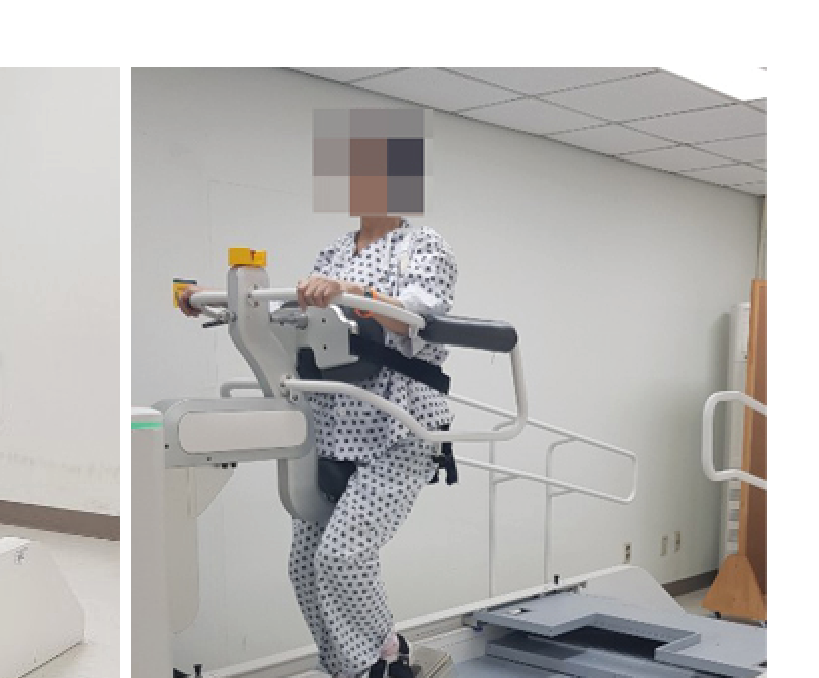
Morning Walk® is an end-effector gait retraining robot, developed by Curexo for lower-limb rehabilitation in patients with gait disorders. Unlike exoskeleton-type robots (which follow the patient’s skeleton) and those with a suspension harness, Morning Walk® partially supports body weight via a saddle, which allows rapid mounting and dismounting — under 5 minutes, including directly from a wheelchair — and reduces the therapist’s effort.

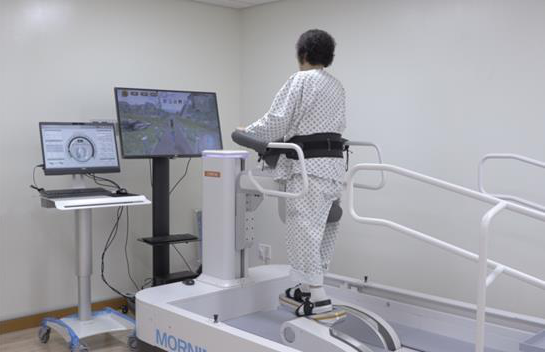
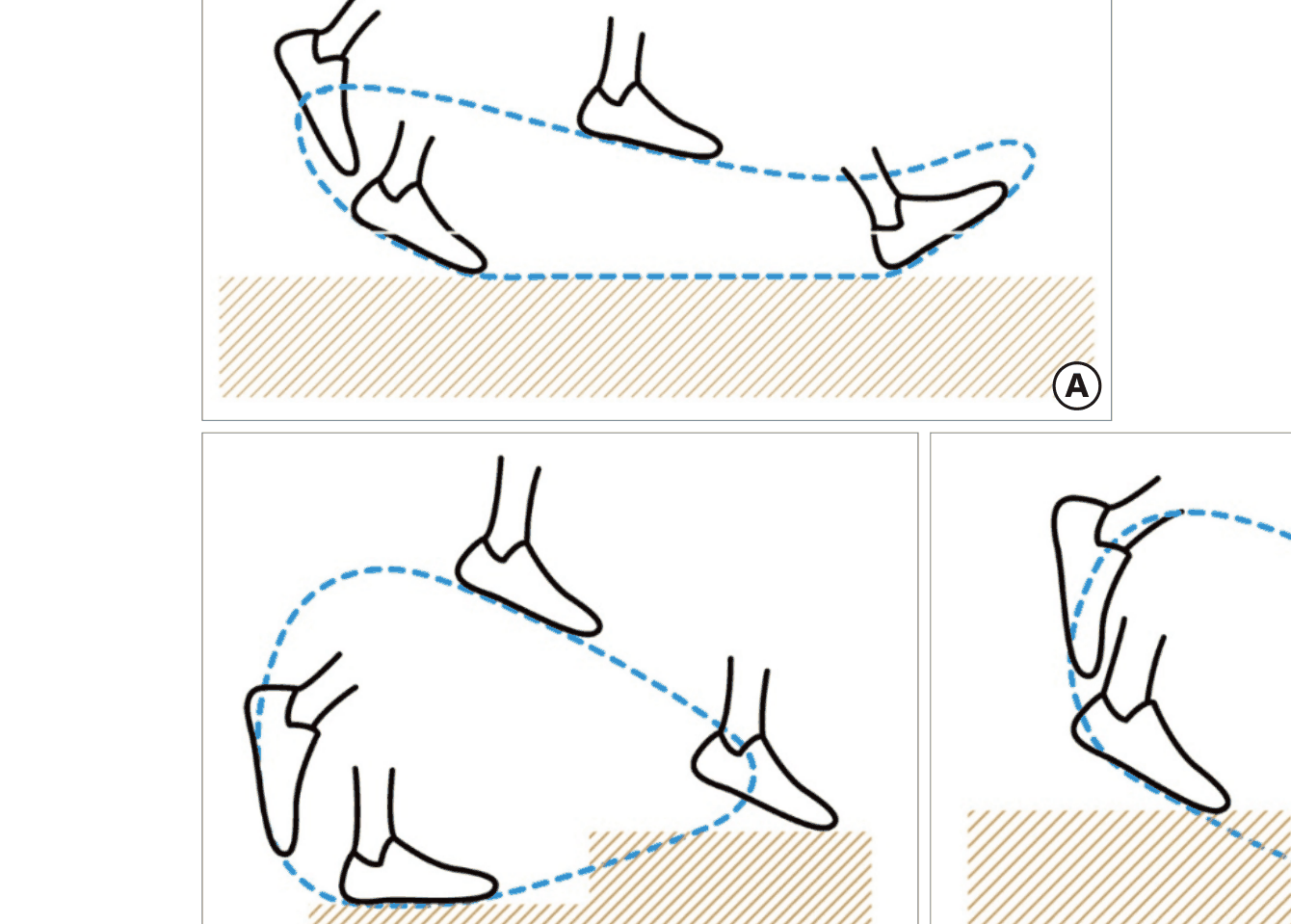
The patient’s feet are placed on two footplates that move independently in the sagittal plane, reproducing the gait trajectory and training the movements of the ankle, knee, and pelvis. The device offers three modes — ground walking, stair ascent, and stair descent — and the therapist can individually adjust the cadence, step length and height, initial contact and toe-off angles, guidance force, and the percentage of body-weight support. Force sensors in the saddle and footplates display, in real time on the monitor, the ground reaction force and the degree of body-weight support, as visual biofeedback for a correct center-of-pressure pattern; virtual reality software shows the patient’s avatar walking along a path. Safety is ensured by a guard bar, a chest support with strap, a trunk fixation belt, parallel bars, and an emergency stop button.

The efficacy and safety of the method are documented by clinical studies in patients with stroke, ataxia, incomplete spinal cord injury, Guillain-Barré syndrome, brain tumors, and after total knee arthroplasty, as well as by evidence at the level of the class of robotic/electromechanical gait training devices (Cochrane review). Morning Walk® was developed together with Hyundai Heavy Industries and Taeha Mechatronics and received FDA approval in December 2014.

Indications
  • Gait rehabilitation in neurological conditions with gait disorders: stroke, ataxia, incomplete spinal cord injury, Guillain-Barré syndrome, brain tumors.
  • Gait rehabilitation in orthopedic conditions, including after total knee arthroplasty (TKA).
  • Gait retraining in patients requiring partial body-weight support.
Key features

Saddle support (not harness)

Rapid mounting and dismounting (under 5 minutes), including directly from a wheelchair; reduced effort for the therapist.

End-effector with independent footplates

Reproduces the gait trajectory, training the movements of the ankle, knee, and pelvis.

Three training modes

Ground walking, stair ascent, and stair descent — for progressive rehabilitation.

Individually adjustable parameters

Cadence, step length and height, angles, guidance force, and percentage of body-weight support.

Visual biofeedback + virtual reality

Ground reaction force and body-weight support in real time on the monitor; avatar on a virtual path.

Integrated safety

Guard bar, chest support with strap, trunk belt, parallel bars, and an emergency stop button.

Clinically validated

Studies in stroke, ataxia, spinal cord injury, Guillain-Barré, brain tumors, and post knee arthroplasty.

Technical specifications
Type
End-effector gait retraining robot, with body-weight support via a saddle
Principle
Two footplates that move independently in the sagittal plane, reproducing the gait trajectory (ankle, knee, pelvis)
Body-weight support (BWS)
Via saddle + chest support (not a suspension harness) — mounting/dismounting in <5 min, including from a wheelchair
Training modes
Ground walking, stair ascent, and stair descent
Adjustable parameters
Cadence, step length and height, initial contact angle, toe-off angle, guidance force, percentage of body-weight support
Step length / cadence
0.30–0.55 m; 4–70 steps/min
Biofeedback
Force sensors in the saddle and footplates → ground reaction force and body-weight support in real time on the monitor; virtual reality software (avatar on a path)
Safety
Guard bar, chest support with strap, trunk fixation belt, parallel bars, emergency stop button
Dimensions / weight
Approximately 3.90 × 1.54 × 1.95 m; ~900 kg
Patient limits
Minimum height ~130 cm; maximum weight ~130 kg (per device specifications)
Development / approval
Hyundai Heavy Industries + Taeha Mechatronics; FDA approved in December 2014
Clinical evidence

A selection of publications and studies that mention use of the system. Summaries are indicative; for details, consult the original source.

Electromechanical-Assisted Training for Walking After Stroke (Cochrane review)

Mehrholz J., Thomas S., Kugler J., Pohl M., Elsner B. · Cochrane Database of Systematic Reviews, 2020; CD006185.pub5

Cochrane systematic review of 62 randomized studies (2,440 participants) on electromechanical/robotic-assisted gait training — the class of end-effector devices to which Morning Walk® belongs — added to physiotherapy vs. physiotherapy alone, after stroke. Evidence at the device-class level, not specific to Morning Walk®.

Patients who received robotic/electromechanical training plus physiotherapy had a significantly greater chance of regaining independent walking (OR 2.01; 95% CI 1.51–2.69); the benefit was greatest in the first 3 months after stroke and in non-ambulatory patients (NNT = 8).
View source

Morning Walk®-Assisted Gait Retraining in Patients After Stroke: A Randomized Controlled Trial

Kim J.Y., Kim D.Y., Chun M.H. și colab. · Clinical Rehabilitation, 2019; 33(3):516–523

Randomized controlled trial (48 patients analyzed) in patients with hemiparesis after a first stroke, comparing Morning Walk® (30 min) plus physiotherapy with physiotherapy alone, 15 sessions over 3 weeks.

The Morning Walk® group achieved a significantly greater improvement in voluntary lower-limb strength (Motricity Index, p=0.034) and balance (Berg Balance Scale, p=0.047) compared with physiotherapy alone.
View source

Morning Walk®-Assisted Gait Retraining Improves Gait and Balance in Patients With Ataxia: A Randomized Controlled Trial

Jung C., Kim D.Y., Kwon S. și colab. · Brain & NeuroRehabilitation, 2020; 13(3):e23

Randomized controlled trial in patients with ataxia caused by brain lesions, comparing Morning Walk® plus physiotherapy with physiotherapy alone, 15 sessions over 3 weeks.

The Morning Walk® group achieved significantly greater improvements in the ambulation category (FAC, p=0.029), gait speed (10mWT, p=0.021), and mobility (Rivermead, p=0.040).
View source

End-Effector Robotic Gait Retraining in Patients With Spinal Cord Injury

Shin J.C., Jeon H.R., Kim D. și colab. · Brain Sciences, 2021; 11(10):1281

Prospective multicenter study (13 patients with incomplete spinal cord injury, AIS C/D), with 20 sessions of Morning Walk® plus physiotherapy over 4 weeks.

All outcomes improved significantly: gait speed (10MWT, p=0.002), balance (Berg, p=0.001), and the ambulation index (WISCI-II, p=0.001), exceeding the thresholds of clinical relevance.
View source

The Effect of End-Effector Robotic Gait Retraining in Patients With Guillain-Barré Syndrome

Rhee S.Y., Jeon H., Kim S.W., Lee J.S. · F1000Research, 2020; 9:1465

Retrospective study (15 patients with Guillain-Barré syndrome), with 24 sessions of Morning Walk® of 30 minutes each.

Significant improvements were recorded in independence (modified Barthel Index, p<0.001), walking distance (2-minute test, p=0.005), and the ambulation category (FAC, p=0.012).
View source

Feasibility of Robotic Gait Retraining With an End-Effector Device in Various Neurological Conditions

Choi S., Kim S.W., Jeon H.R. și colab. · Brain & NeuroRehabilitation, 2020; 13(1):e6

Feasibility study in 189 patients with various neurological conditions (brain lesions, spinal cord injury, Parkinson’s disease, peripheral neuropathies, pediatric patients), treated with Morning Walk®.

88.4% of patients completed the 24 sessions, with no serious adverse events (no neurological deterioration, falls, fractures, or skin lesions), confirming the feasibility and safety of the method.
View source

Robotic Gait Retraining in Patients With Gait Disorders Caused by Brain Tumors (Case Series)

Jung M., Kim D.Y., Chun M.H. · Brain & NeuroRehabilitation, 2018; 11(2):e21

Case series of 3 patients with primary brain tumors and gait disorders, treated with Morning Walk® plus physiotherapy, 15 sessions over 3 weeks.

Balance (Berg Balance Scale), mobility (Rivermead), and functional status (Karnofsky) improved in all 3 patients; the authors note, however, an increase in fatigue, recommending adaptation of the protocol.
View source

Five-Day Rehabilitation After Total Knee Arthroplasty With an End-Effector Gait Robot as a Neuromodulation Tool

Koo K.I., Hwang C.H. · PLOS ONE, 2020; 15(12):e0241117

Randomized controlled trial (interim analysis, 14 patients) after total knee arthroplasty (TKA), comparing rehabilitation with Morning Walk® with rehabilitation using a walking frame, 3 times a day for 5 days.

Rehabilitation with the robot produced a significantly greater strengthening of the knee flexors (p=0.04), with a real-time reduction in muscular load — suggesting a neuromodulation effect.
View source
Certifications & compliance
FDA approval (December 2014)
Images
Morning Walk® — a patient during robotic gait retraining, supported by the saddle (Curexo material)
Morning Walk® — training with visual biofeedback and virtual reality on the monitor (Curexo material)
Morning Walk® — the footplate trajectories for ground walking, stair ascent, and stair descent (Curexo material)