Ronda Medical
OrthoPediatrics

Fassier-Duval (telescopic IM system)

A telescopic, self-extending intramedullary nail that lengthens as the bone grows — a reference solution for osteogenesis imperfecta and other skeletal dysplasias.

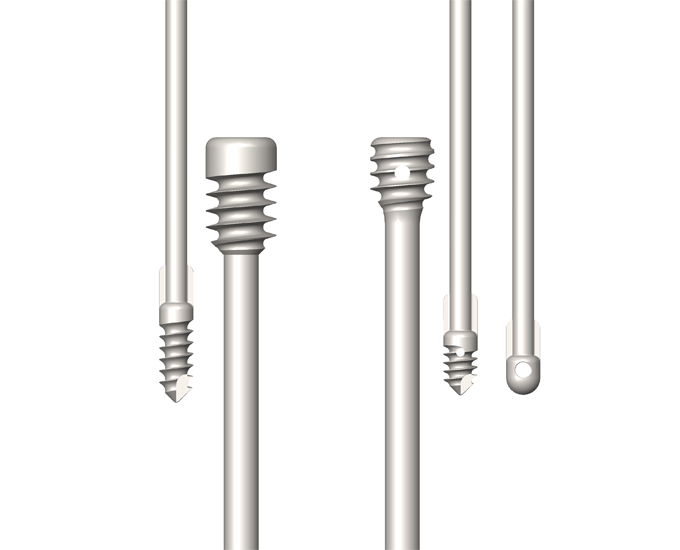
Components of the Fassier-Duval telescopic nail (male and female, with threaded fixation)
Ø3.2–6.4 mmDiameters
420 mmMax length
Stainless steelMaterial
Single pointApproach
Clinical description

Fassier-Duval is a telescopic intramedullary nailing system developed by Pega Medical (an OrthoPediatrics group company), designed for patients with osteogenesis imperfecta (OI), skeletal dysplasias, and other bone deformities. The nail lengthens (“telescopes”) as the bone grows, preventing or stabilizing fractures and correcting long-bone deformities during growth.

The system consists of a female component, anchored in the proximal cortex, and a male component, anchored at the distal epiphysis, with threaded fixation. Unlike conventional telescopic nails (Bailey-Dubow, Sheffield), Fassier-Duval uses a single entry point, reducing invasiveness.

It is used as a temporary implant for the healing of diaphyseal fractures, osteotomies, nonunions, and malunions, and for the prevention of fractures of the femur, tibia, and humerus in pediatric patients. It can also be used in bone lengthening/shortening, together with external fixators, in pediatric or small-stature patients with limb-length discrepancy.

Indications
  • Stabilization and prevention of long-bone fractures (femur, tibia, humerus) in children with osteogenesis imperfecta and skeletal dysplasias.
  • Healing of diaphyseal fractures, osteotomies, nonunions, and malunions.
  • Correction of long-bone deformities during growth.
  • Bone lengthening/shortening (together with external fixators) in patients with limb-length discrepancy.
Key features

Lengthens with growth

A self-extending telescopic nail that “grows” with the bone, preventing/stabilizing fractures.

Single entry point

Unlike conventional nails (Bailey-Dubow, Sheffield), it reduces invasiveness.

Threaded fixation

Female component (proximal cortex) + male component (distal epiphysis), with threaded anchoring.

Reference in OI

A solution widely used for osteogenesis imperfecta and skeletal dysplasias.

Product gallery
Components of the Fassier-Duval telescopic nail (male and female, with threaded fixation)
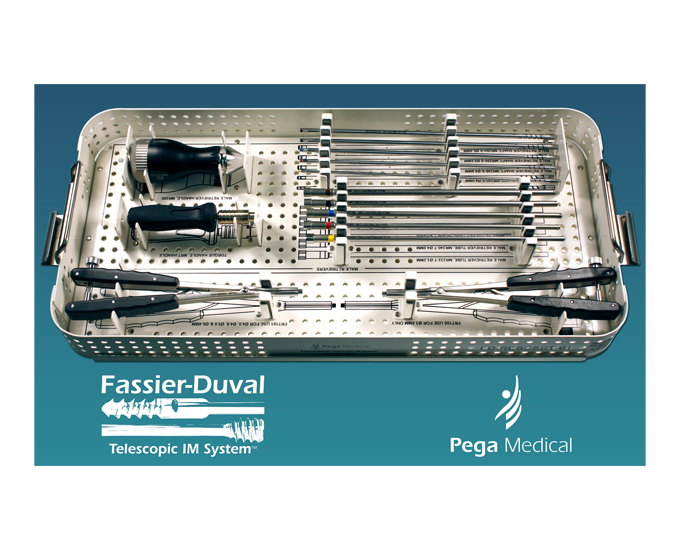
Fassier-Duval instrument set (Generation IV)
Technical specifications
Type
Telescopic intramedullary nail (self-extending)
Available diameters
3.2 · 4.0 · 4.8 · 5.6 · 6.4 mm
Maximum length
up to 420 mm
Material
Stainless steel; also available in a sterile version
Construction
Female component (proximal cortex) + male component (distal epiphysis), threaded fixation
Approach
Single entry point (reduced invasiveness)
Anatomical locations
Femur, tibia, humerus
Clinical evidence

A selection of publications and studies that mention use of the system. Summaries are indicative; for details, consult the original source.

Are Fassier-Duval rods at risk of migration during spinal MRI?

Makhdom A.M., Fassier F. și colab. · Journal of Pediatric Orthopaedics, 2015

A study that evaluated the risk of migration of Fassier-Duval rods in patients with osteogenesis imperfecta undergoing spinal MRI (1.5 T magnet), as well as heating effects and artifacts. Conclusion: FD rods are safe at 1.5 T MRI, with no significant migration, heating, or artifacts.

View source

Retrograde application of the Fassier-Duval rod in the humerus in osteogenesis imperfecta: a new surgical technique

Marwan Y. și colab. · Journal of Pediatric Orthopaedics, 2022

A description of a retrograde humeral rodding technique with Fassier-Duval in children with OI, for fractures/bowing of the distal half of the bone. In the 6 patients included, all fractures/osteotomies healed with functional alignment, with no intraoperative surgical complications.

Certifications & compliance
CE marking FDA cleared (USA)

Would you like information about Fassier-Duval (telescopic IM system)?

The Ronda Medical team provides details about availability, configurations, and technical support.

Contact the team