
Ronda Medical
OrthoPediatrics

Hinge Plate (pediatric plating system)

A hinged plate for guided growth — corrects angular deformities in children (e.g. genu varum/valgum) through a true hinge placed at the growth plate, without osteotomy.

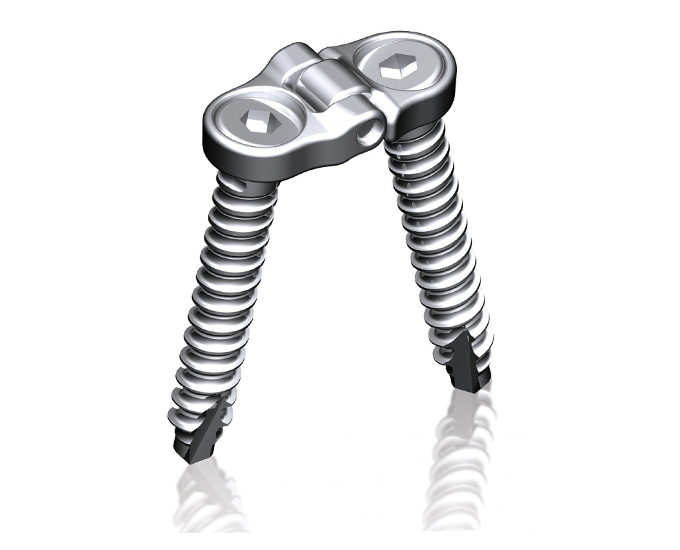
Hinge Plate — hinged plate with two screws (official render)
1 plate + 2 screwsComponents
12 / 16 / 20 mmPlate sizes
Ø4.5 mmScrews
SS316LMaterial
Clinical description

The Hinge Pediatric Plating System is a hinged plate developed by Pega Medical (an OrthoPediatrics group company) for the correction of angular deformities in children and adolescents through the principle of guided growth. The system comprises a plate and two screws and is fixed on either side of the growth plate (physis), controlling axial growth and gradually correcting the deformity.

Unlike deformable plates without a mechanical hinge — which generate stresses and pull-out forces on the screws — the Hinge Plate places a true hinge exactly at the growth plate. The unconstrained angular correction around this pivot point reduces structural stresses on the device and the risk of implant failure.

The plate continuously conforms to the bone surface, without stress, allowing a gentle and minimally invasive correction while avoiding osteotomies. The system was developed in collaboration with Dr. Daniel Green (Hospital for Special Surgery, New York).

Indications
  • Temporary correction of angular deformities of the long bones through guided growth.
  • Knee (femur and tibia): varus, valgus, flexion, or extension deformities.
  • Elbow (humerus): valgus or varus deformities.
  • Wrist (radius and ulna): flexion or extension deformities.
  • Ankle: varus, valgus, or plantar flexion deformities.
Key features

True hinge at the physis

Ideal placement of a true hinge at the growth plate allows guided management of the deformity.

Unconstrained correction

Free angular rotation around the pivot point reduces stresses and the risk of implant failure.

Stronger screws

Reinforced screw design, adaptable to different bone morphologies.

Simple, minimally invasive technique

A gentle correction that avoids osteotomies; a precise and simple surgical technique.

Product gallery
Hinge Plate — hinged plate with two screws (official render)
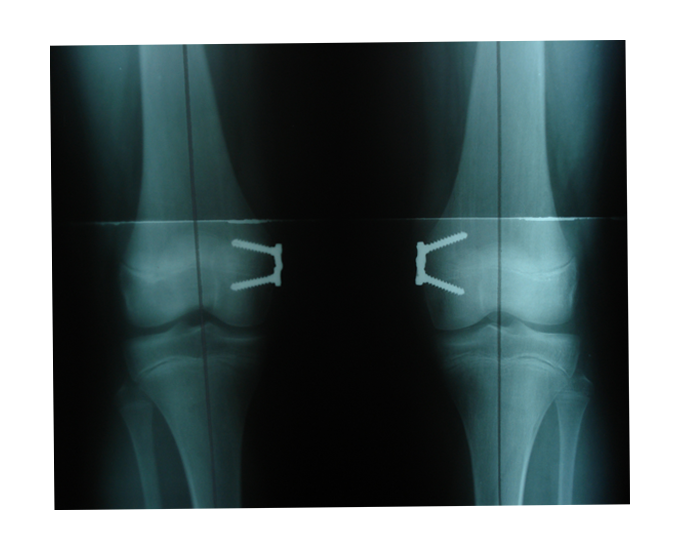
Radiograph: Hinge Plate applied bilaterally at the knees
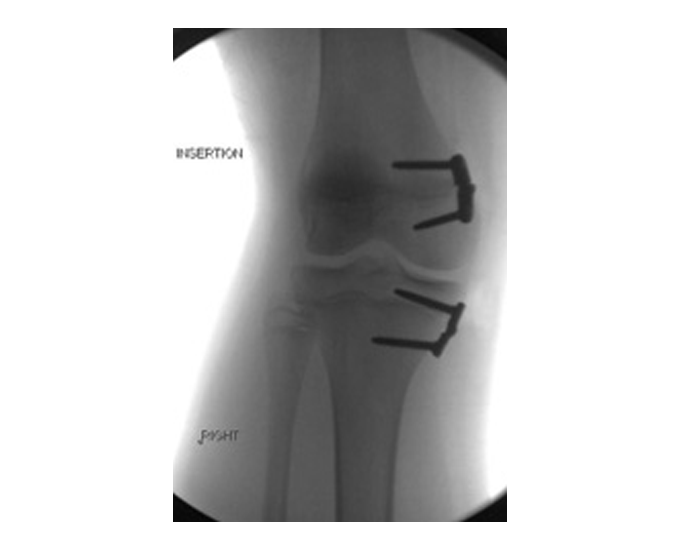
Radiograph: deformity correction at the knee with the Hinge Plate
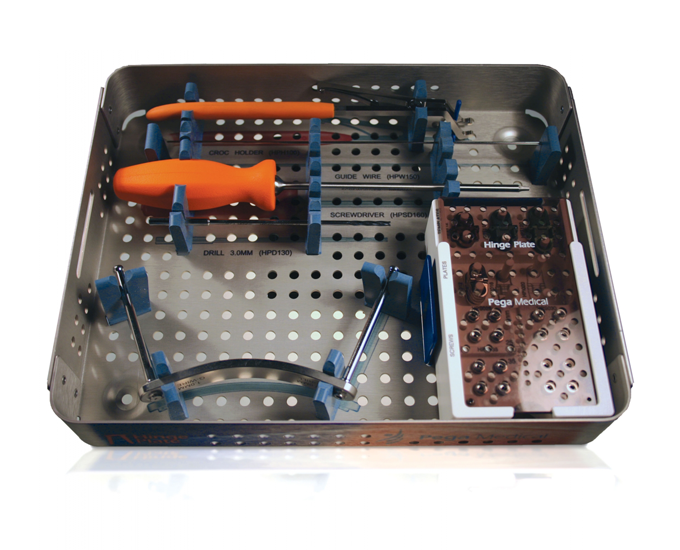
Hinge Plate instrument tray (Pega Medical)
Technical specifications
Type
Hinged (articulated) plate for guided growth
Material
Medical-grade 316L stainless steel (ASTM F138)
Components
One plate + two screws
Plate sizes (distance between anchor points)
12 mm (S) · 16 mm (M) · 20 mm (L)
Screw lengths
Ø4.5 × 25 / 30 / 35 mm
Plate codes
HPI012 · HPI016 · HPI020
Screw codes
HPS025 · HPS030 · HPS035
Delivery
Non-sterile (to be sterilized before use); single-use
Clinical evidence

A selection of publications and studies that mention use of the system. Summaries are indicative; for details, consult the original source.

Rotational guided growth: a preliminary study of its use in children

Paley D., Shannon C. · Children (MDPI), 2023

The study describes a minimally invasive technique for correcting rotational deformities of the femur and tibia, using separate Hinge Plate halves fixed to the epiphysis and metaphysis and connected with flexible bands (Fibertape). All patients corrected their rotational malalignment, without open surgery.

8 bones in 5 patients (mean age 8.4 years); mean correction of 30° in the femur and 9.5° in the tibia, over ~12 months.
View source

Would you like information about Hinge Plate (pediatric plating system)?

The Ronda Medical team provides details about availability, configurations, and technical support.

Contact the team